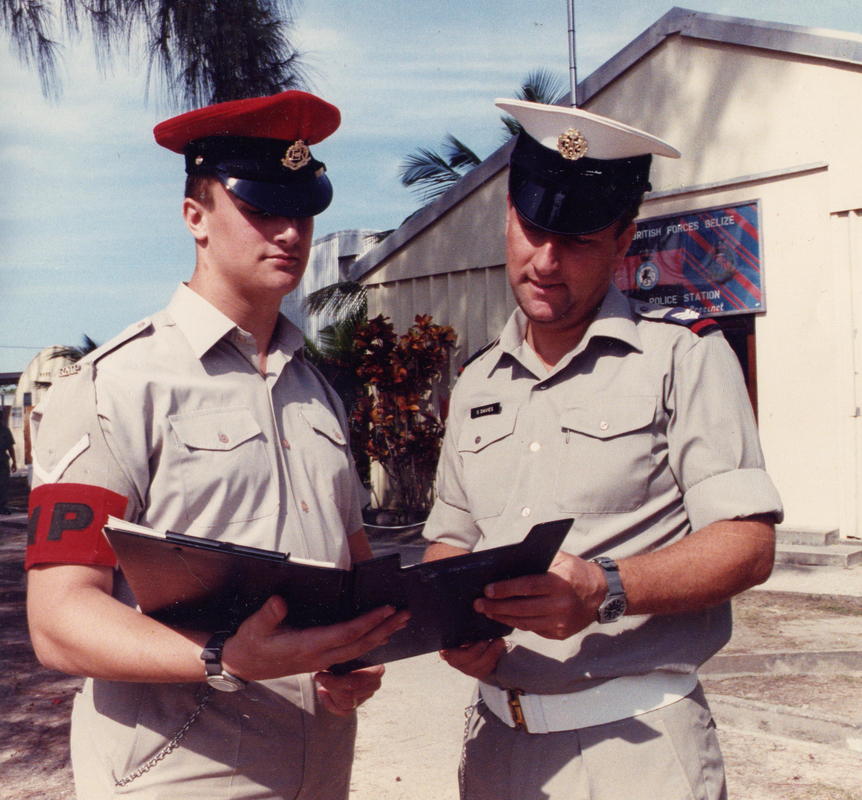
Stephen R Davies was a member of the Royal Air Force Police for 25 years. In 1975 he joined the Royal Air Force as a policeman and during his service completed tours of duty in the UK and numerous countries around the globe. He qualified as a specialist in Royal Air Force Police Special Investigation and Counter-Intelligence matters and successfully completed the Home Office Detective Training program and Drug Enforcement courses with the UK civil police and United States Air Force Office of Special Investigations. In 1991 he qualified as an instructor and lectured at the Airman’s Command School Hereford and the RAF Police School at Halton. He retired from the Royal Air Force in 2000 and now lives in Portugal.
THE PROJECT
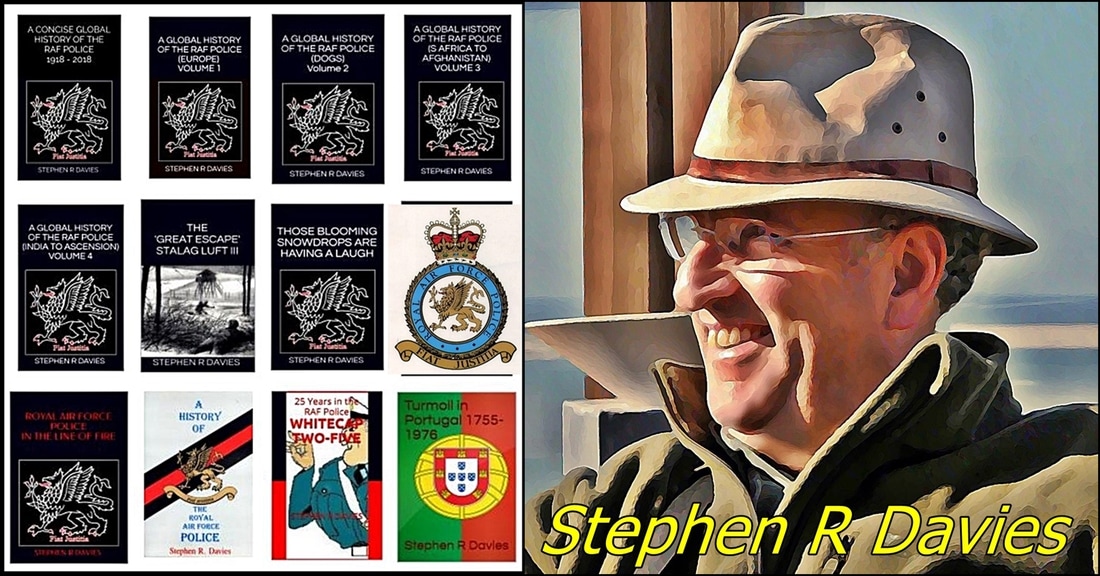
Since 1993, Stephen R Davies has been researching the complex history of the RAF Police since its formation on the 1st April 1918. During his 25 year research into the history of the RAF Police, he has amassed one of the largest depositories of information regarding the global activities of the branch dating back to the very beginning.
Steve says, "The project began after I managed to obtain a rather thin A4 glossy magazine which had been produced to commemorate the 75th anniversary of the RAF Police. The contents were mostly photographs with a very sparse story of the RAF Police up until that point. Being rather disappointed with the publication and lack of substance, I closed the magazine and was heard to utter those immortal words, "For Goodness sake, is that it..? I could have done a better job than that..!!" ... The rest as they say is history...! Seriously though, up until that point, although the RAF Police had a 'museum' containing lots of artefacts gathered from around the RAF Police world, there was no documented chronological global history of the branch, and although one should never 'sound one's own trumpet' I have to say that if I had not taken on this project, with a great deal of help from former and serving RAF Police, then the RAF Police would certainly not have had such an impressive written history as they celebrated their centenary on the 1 April 2018. Disappointingly, during the period of my research, only two out of ten serving Provost Marshals, actively supported my project and went out of their way to assist me. What is more surprising, is that both were not 'professional' policemen; Air Cdre J L Uprichard was a pilot and Air Cdre P J Drissell was a member of the RAF Regiment, and both deserve my sincere admiration and thanks."
"In the lead-up to 2018 many authors had been working hard to compile the history of the Royal Air Force during its first 100 years but most focused on its impressive flying exploits and the aircrew rather that the incredible support to flying operations given by the often forgotten personnel from a multitude of ground trades who have worked tirelessly to keep the aircraft flying for the past 100 years. My intention however, was to produce a book, comprising several volumes, which offers readers and historians alike a valuable insight into what the RAF Police have achieved during those first 100 years at home and abroad and I'm sure the book will make a valued addition to the records held by the RAF Historical Branch for future generations to refer to."
THE AUTHOR
Stephen R Davies was born in North Wales in August 1955; he is the eldest of 3 children and was educated at Blessed Richard Gwyn School in Flint. After serving as a Special Constable for 2 years with the North Wales Police, he joined the RAF Police in January 1975. After completing Recruit Training at RAF Swinderby, Driver Training at RAF St Athan and Police Training at RAF Newton, he was posted to RAF Wyton in Cambridgeshire where he was employed on General Police Duties for 2 years.
Between May 1977 and November 1979, he was stationed at RAF Laarbruch in West Germany on Nuclear Security and General Police Duties until February 1978, when he was promoted to substantive Corporal. After an initial spell as a Junior Shift Supervisor he was later employed within the Counter-Intelligence Office in the RAF Police Headquarters and in December 1978 he was detached to Berlin.
Between 1979 and 1981, he served with the RAF Police Support Squadron based at the Headquarters Provost & Security Services, Rudloe Manor, and besides travelling the world, successfully qualified as a Special Investigator (SI).
Between 1981 and mid 1983, he served with the Special Investigation Branch at Provost & Security Services (Scotland) and between January - July 1983, was detached as the RAF Police investigator on Ascension Island.
At the end of 1983, he was promoted to Sergeant and posted to RAF Marham as the Relief Shift Sergeant. During that time he was detached to RAF Greenham Common and RAF Unit Goose Bay Canada and completed an Improvised Explosive Device Evacuation Controllers Course with the Army in Kent.
Between October 1984 and April 1985, he was posted to Airport Camp Belize in Central America as the Senior NCO in charge of the RAF Police and on his return to the UK was posted back to the RAF Police Support Squadron. In 1986 he completed the Home Office Detective Training Course with the Lancashire Constabulary in Preston and transferred to the Special Investigation Branch at Provost & Security Services (Southern Region) based at Rudloe Manor.
In 1987, he completed an exchange detachment with the Royal New Zealand Air Force Police in New Zealand before returning to the Special Investigation Branch at Provost & Security Services (Southern Region) to head-up and justify a newly formed Drug Intelligence Team (DIT). Having justified the DIT and having completed an Undercover Drug Operations Course with the United States Air Force Office of Special Investigations and other drug related courses with the UK civilian Police and Royal Navy, he was posted back to Belize for a second 6-month tour of duty as the Senior NCO in charge of the RAF Police.
Returning to the Special Investigation Branch at Provost & Security Services (Southern Region) Rudloe Manor, he was promoted to Flight Sergeant in late 1989, and took over the Drug Abuse Prevention Flight which amongst its many inquiries, investigated an airman who was injecting Heroin on a daily basis; two RAF Sergeants who had smuggled 7 kilos of Cocaine into the UK and; another airman who had been arrested in possession of a kilo of Cocaine, having been recruited by a London crime syndicate to smuggle drugs into the country from Amsterdam.
From the beginning of 1991, he began a 3 year tour as an Instructor at the Airman's Command School (General Service Training 2), Hereford. In early 1993, after discovering that the branch had no credible history on record, he began researching the Global History of the RAF Police. In early 1994, he was posted to RAF Shawbury as the Senior NCO in charge of the RAF Police and soon after, completed a Counter-Intelligence course at the RAF Police School Newton. His first book, ‘Fiat Justitia – A History of the Royal Air Force Police’ was published in April 1997, and was well received. However, his research continued in an effort to record the first 100 year global history of the branch.
For a number of years he had also volunteered his services in various posts at the annual (Royal) International Air Tattoo. In early 1998, he was posted onto the staff at the RAF Police School, Halton, as the Senior Instructor/Supervisor with the Police Training Flight. In the spring of 2000, having completed 25 years service, he retired from the RAF and together with his wife, moved to live in Portugal.
In February 2009, he acted as a Specialist Consultant for, and appeared in, the National Geographic television documentary 'The Great Escape – Revenge on the Gestapo', which tells the story of the post war murder investigation undertaken by the RAF Police Special Investigation Branch, to bring to justice the surviving Nazis involved in the execution of 50 RAF officers who had escaped from the Stalag Luft III Prisoner-of-War Camp at Zagan in March 1944. He became a member of the RAF Police Association in August 1993 and was one of 4 National Trustees for fifteen years.